So I'm writing this post as I'm trying to sweep glitter up into a dust pan. It is not going well, to say the least.
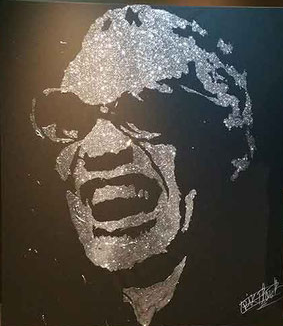
I guess that means that I finally did it! I graduated from pencil and paper and entered the realm of black paper, glue, and glitter. Was the end product just a blob of glitter or an actual tangible face? Watch to find out:
Disclaimer: The end-product looks super bad up close, but looks kind of good far away. Make of that what you will.
I am aware this video is pretty long, but I wanted to take you guys with me in the process of glitter painting as well as share my inspiration and resources (I already cut out a lot more than I wanted), so please bear with me and my short film.
I also thought it appropriate to end this entry with my new evil nemesis who is out to get me friend:
There's been a slight change in plans. The original plan was to do my speed paints with just portraits that were from the neck-up. There's been a new development, however, and I've decided that I was going to try my hand at a full body painting. This presents some new challenges that I can identify right away, and the possibility for new potential problems.
Concern #1: It's going to be hard to make it look good.
All the examples that I've scoured the internet for have been strictly facial portraits:
(Exhibit A, B, & C)
The facial details that allow an audience to really identify and recognize the person being painted is one of the major components of glitter speed painting. And that scares me. I might have to make some adjustments, like a bigger canvas, finer tools, but first, I just want to jump headfirst into the water. If that water happens to be shark-infested or too shallow, or there's rocks at the bottom, I can just figure that out mid-flight.
But all jokes aside, I did want to expand beyond the limitations that glitter speed painting usually has. I want to try something, not only new to me, but maybe new to everyone. And I've also found a reference photo that I just cannot pass up, so I decided to try my hand at it, and if it fails miserably les misérably?, then I'll backtrack and go with plan B.
Have I come up with a plan B yet? Unclear.
Concern #2: This sets my schedule back a bit.
Now, I am very aware that me adding a whole new concept to learn this late in the game is dangerous, needless to say. But, I think it might be totally worth it. And what's the harm in taking risks in the biggest, most important project of the marking period that relies solely on my planning and time management skills?
Looking back now to blog #1, my timeline is more of one week of concentrated learning, and then the rest are just practice, practice, practice! So, I think I can afford to lose one week of maybe much needed practice and try this out.
Now that I've got these concerns said and documented (so I can look back later and realize they were all correct and I've indeed shot myself in the foot), it's time to learn how to sketch the full body.
Like last week, it's time for a control. But no science experiment this time (I've had enough of that). This time, I'm using a random reference photo that I'm not going to be considering for the actual project. The photo I want to use has more complex poses and body maneuvers, so I'm starting with just a basic pose. The place to find that is stock images:
You see, this isn't what I want. Far too intricate, and to be honest, I don't think anything I could draw could live up to the pure artistry of the photo.
And I just wanted to mention that when I pulled this photo from google images, the title of it was "cool guy". Cool guy indeed.
I'm going with this guy! He seems nice enough.
Also, when I saved the image above, the file name--the file name was very weirdly specific?
vvv
This isn't even important to my blog, I just wanted to share the bizarre thing I came across.
Now that I've chosen my reference photo, the one with a very specific file name, it was time to begin drawing the control. I drew a sketch of the photo before I actually learned anything...and the results were questionable, but had the potential for redemption the path to redemption.
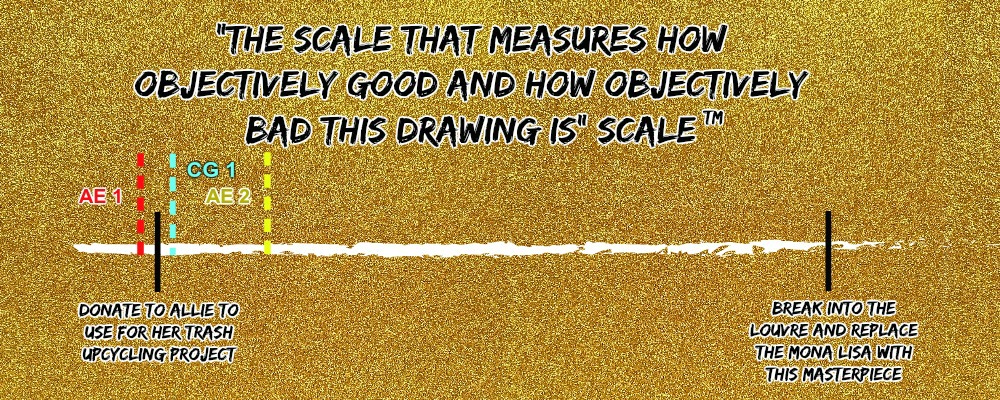
Like I said, has merit, but needs much improvement. So let's put it on my objective scale! My second opinion isn't available this week, she had her own blog to do.
CG 1 stands for "Cool Guy 1".
I have not asked Allie if she would take this drawing yet, but I'm going to presume that she would appreciate it. However, I think it is a far cry from the second Albert Einstein portrait I drew last week, which I do say, I'm moderately proud of.
Now this sketch, I'm not proud of. So to improve, here are my biggest grievances with the sketch that I'm going to work on:
Summing these up into this week's goals, we have:
Today, I focused on the simplified full-body human figure. In the video below, I draw the main sketch, as well as an example of what it looks like when the sketch goes wrong.
I wanted to preface that I have like two or more sketches that didn't quite pan out, just like the last one in the video. Like this one:
But not to worry! Because I got it right, and it was time to move on to drawing the actual reference photo again.
I think that my proportions definitely improved, and I got the general silhouette of him down.
And on my scale, I've placed it here:
While it's proportional, the details don't make it super distinctive, so it's chilling here.
Since I won't be painting people that just stare straight-ahead in a coffin, I need to work on poses. Of the beginner lessons I found, the foundations for drawing different poses feature more of just tips for different categories of poses. But in general, the idea is to sketch out the pose with the same lines and circles at the joints that the full-body figure has. The sketch should also maintain balance, with the center of gravity and center of support aligned in a vertical line.
The points at which the feet (or whatever limb is being balanced on) touches the ground form a line. The midpoint of that line is the center of support.
The center of gravity is behind the belly button, and those two points should be aligned on top of each other so a vertical line can go through them.
It's not just a line they can form either, since she is supporting her weight on her feet and one of her hands, it forms a triangle, and the center point of that triangle serves as her center of support.
The center of support also tends to lean to the side that the most weight is being put on.
The is an over-simplification of the idea, but it's a good starting point to drawing out poses.
I decided to try my hand at the running pose and a pose from a reference photo of my choice:
(Excuse the watermark, I don't know who invited her.)
And I have to say, I'm actually really proud of the sketches I ended up making:
(some issues on YouTube, comment if there are still issues here)
I'm really happy with the end products. They're definitely nowhere near Louvre material, but since I've always struggled with proportions and drawing, the dancing one especially makes me feel like I've actually made some decent progress!
Again, a completely objective scale.
Drawing really isn't as hard as I first thought. It just takes a couple tries to work out the kinks (like that strangely alien looking person), and then it goes alright. In the weeks to come, I'd like to learn the creative, artistic side of making portraits, and get to GLITTER. It's time to lay tarp over every inch of my entire house.
Hope to see you back when I update on the very very messy antics to come.
According to Einstein, "Failure is success in progress.", and as annoyingly cheesy as that sounds, who knows? Maybe the 160-IQ Nobel Laureate has a point.
Because what better way to kick off my first portrait of the Genius Project by drawing an actual genius!
In the spirit of my subject this week, Albert Einstein, I am conducting an infallible scientifically scientific science experiment* to see how my drawing skill set improves after actually learning how to draw. But first, I need a hypothesis.
*Not infallible, scientifically scientific, or science. Sorry Mr. Einstein.
Hypothesis: If I learn more about portrait drawing, then I'll get better at portrait drawing! (Results are shocking!)
Like any infallible scientifically scientific science experiment, I need a control. I drew Einstein with no prior knowledge, technique, or any clue how to draw him, just based off of the reference photo. Then, I rated it on the "The Scale That Measures How Objectively** Good and How Objectively** Bad This Drawing Is" Scale™.
**Not objective. Like at all. In fact it's literally the most subjective way to evaluate this.
For more input, I am also including a questionnaire to help evaluate the drawing's position on the spectrum. To make sure everything is completely objective (still not objective at all), I asked for a second opinion.
1. Does it resemble my subject even the slightest bit?
Second Opinion: I mean.... I guess
2. Are the proportions accurate and realistic?
Second Opinion: I'm pretty sure Einstein had a big forehead but other than that...I can tell it's a mammal...
3. How close does it match the reference photo?
Second Opinion: Better than I can do.
4. Would you buy it if sold?
Second Opinion: I think you should pay me for my eye doctor bill.
Wow that's kind of harsh, Second Opinion. But taking everything in to account, let's see what our results are:
I tried asking her. She wouldn't take it.
After the evaluation, my portrait, from what we can all obviously see, struggles quite a bit in the proportion arena, so what I'm looking for this week is a full understanding of the proportions of the standard human face. I will first be learning how to draw a simplified version of it, which I can then build off of. Since most people's features aren't perfectly symmetrical or perfectly aligned and proportional, I'm also looking to be able to adjust these proportions to an image of a real person.
In particular, the jaw of my Einstein has many weird and off peculiarities. It really has no shape beyond the two-dimensional plane and looks nothing like his actual jaw, so I'll be concentrating on the proportions of the jaw, especially, along with the rest of the face.
Now, the hair of my Einstein is also pretty laughable (ramen noodles?) but I don't think I'll be prioritizing hair and the physics of hair, since glitter speed painting doesn't really entail drawing in any extreme detail.
So to reiterate, my goals are to:
Now let's go back to science experiment. My independent variable: learning how to actually draw a portrait.
Now, knowledge (wow!) leads me to believe that the classic techniques for portrait drawing starts with a vertical line down the center, a horizontal middle line, a hairline, etc. But to be frank, I always thought of it as a huge waste of time (not that I have better things to do). Why do that when you can do it by eye?
Here's a hint: This is why.
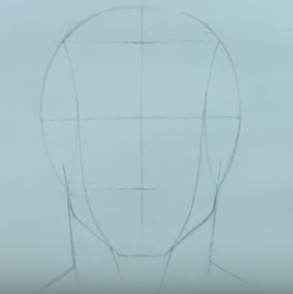
After intensely viewing and taking notes on thesevideosfromvariouschannels, I now have several pages about the Loomis Method, named after the famous technique by Andrew Loomis in his book "Drawing the Head & Hands". This method of portrait drawing deconstructs the head into the cranium and the jaw, using guidelines (like the vertical and horizontal lines) to proportion the features of the face. These videos tutorial how to draw the simplified version of the human head, and it was the best place to start building the fundamentals.
So let's break the Loomis Method down:
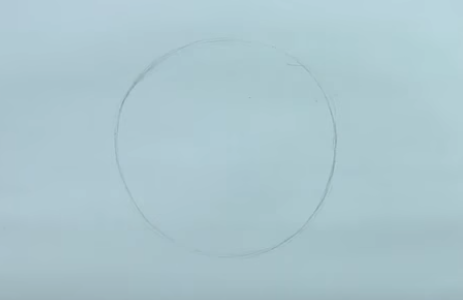
1. Draw a circle to represent the cranium of the head.
As I previously mentioned, the Loomis Method deconstructs the human head into the cranium and the jaw, the cranium being circular and the jaw being more of a boxy wedge shape.
We draw the cranium first because the Loomis Method depicts the jaw as more of an attachment to the cranium, which acts as the base for the entire face.
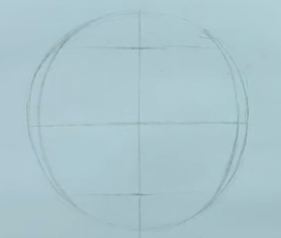
2. Drawing the center and browlines.
The key for maintaining proportions in the Loomis Method is drawing lines for each of the features at different distances. We begin this by drawing the center line going down vertically, and the browline, which goes across horizontally.
3. Draw the hairline, the line at the bottom of the nose, and the chin
The hairline is 2/3 of the way up from the nose
The bottom of the nose ends 2/3 away from the browline
4. Adjust the head shape based on the angle
Most people' faces aren't rounded, they are more of an oval
The inner curves trimming down the circle
It was during research on this step when I found out the slew of people's different face shapes, jaws, eye shapes, which all have different names. Kind of makes me wonder why there's a standard human face shape at all.
5. Attach jaw and touch up rest of sketch.
Draw the jaw from the bottom curve of the cranium. The jaw goes out, then tapers off to meet the chin
Connect the curves on the sides of the face with the chin
Draw in the neck and shoulde.r
And you're done!
Note the rule of thirds: a general guideline that the hairline to the brow-line, the brow-line to the bottom of the nose, and the bottom of the nose to the chin all have equal increments of space between them.
These are first baby steps to the Loomis Method, and I continued with learning about where to place face features, positioning due to angles, and how to adjust this sketch to any photo. After all my research, I redid my Albert Einstein sketch to test the results:
Personally, I think it's a HUGE difference from before. The proportions, while not perfect, look right, jaw looks more like the image, the nose even looks better. I even did a better job at the hair, which I was not trying to learn this week. It still has a long way to go, but let's put it on the scale.
And if we go back to our "experiment", I can confirm that when you learn about portrait-drawing, you get better at portrait drawing.
I think it's safe to say, I reached all my goals for Week 2!